



The Stellar Community Fund (SCF) is an open-application awards program that draws on community input to support developers and startups building on Stellar. The SCF Build Award operates in 6-week rounds, including two-step panel review process and community vote.
SCF #42 continues under SCF 7.0, a significant structural shift that introduced three distinct tracks: the Open Track for novel on-chain use cases (reviewed by the delegate panel and voted on by the community), the Integration Track for projects building on existing ecosystem tools (reviewed by the delegate panel only), and the RFP Track for targeted developer tooling needs (reviewed by the delegate panel only).
We received 83 submissions across all three tracks. Thank you to all submitters and reviewers for your hard work!
27 projects were awarded across all three tracks with a total of $2,461,916 worth of XLM. Click on the project name to view their successful submission! Please note that in order to view the SCF Dashboard, you need to be logged in. If you do not yet have an account, you can create one by signing up with Discord.
Build Award Recipients**
Projects can request an SCF Build Award up to $150,000 worth of XLM*. The SCF Build Award is for projects which have significant (user) traction OR teams that are experienced in the Stellar ecosystem and have identified a validated need, both with a well thought out plan and architecture to be ready to build upon receiving the SCF Build Award. Learn more in the SCF Handbook.
Open Track
Novel on-chain use cases — reviewed by the delegate panel and voted on by the community via Neural Quorum Governance (see more details below). 7 of 32 submissions were awarded.
AXIS — $136,000 worth of XLM*
AXIS is a smart contract limit orderbook backward-compatible with Classic Stellar DEX, combining off-chain matching with on-chain settlement in a completely trustless, non-custodial model.
Zarf Protocol — $40,000 worth of XLM*
Zarf is a non-custodial payment and token distribution application on Stellar that enables users to send funds or create vestings to an email address instead of a wallet address.
Tezoro — $143,800 worth of XLM*
Tezoro is a DeFi aggregation tool that aggregates Stellar protocols and routes activity across chains, letting users access DeFi opportunities with automated diversification powered by AI monitoring.
ACTA — $75,000 worth of XLM*
ACTA is a Verifiable Credentials API/SDK on Stellar enabling startups, DAOs, and businesses to issue and verify trusted digital credentials, replacing fragmented verification with reusable, independently verifiable credentials anchored on-chain via Soroban.
Regulated BRL Settlement for FX and Institutional Payments on Stellar — $96,000 worth of XLM*
BRLP is a regulated BRL settlement token issued on Stellar for institutional FX, institutional payments, and crypto-to-fiat reconciliation, replacing bilateral reconciliation with near-instant finality and compliance-by-design.
Arcane | Enterprise Private Compliant Layer for Stellar — $150,000 worth of XLM*
Arcane is a non-custodial, compliance-by-design enterprise privacy infrastructure for Stellar that enables confidential compliant transactions with built-in auditability and selective disclosure.
Nectar Network — $75,000 worth of XLM*
Nectar Network is a generalized automation and liquidation layer for Soroban DeFi, enabling protocols to register time-sensitive on-chain tasks — liquidations, automated compounding, oracle updates, rebalancing — executed by keepers participating in a reward-based execution layer.
Integration Track
Projects building on existing ecosystem tools — reviewed by the delegate panel only. 19 of 44 submissions were awarded.
Bando — $75,000 worth of XLM*
Bando is a B2B treasury management platform that enables Mexican companies to access tokenized CETES (Mexican Federal Treasury Certificates) through the Stellar network using Etherfuse’s Stablebonds.
Backyard Finance — $100,000 worth of XLM*
Backyard lets users configure DeFi strategies for stablecoins by allocating across multiple DeFi strategy vaults, coordinating capital through a ve(3,3)-style system.
Lumexo — $140,000 worth of XLM*
Lumexo is a non-custodial financial interface built on the Stellar network that unifies decentralized finance tools — including SDEX trading, liquidity pools, lending, and fiat on-ramps — into a single, accessible system with native iOS and Android apps.
Digitpay Finance — $80,000 worth of XLM*
Digitpay simplifies how individuals and businesses send, spend, receive, and manage money across borders, making digital finance intuitive and accessible especially for users in the African market.
Institutional Liquidity Infrastructure for Stellar — $115,000 worth of XLM*
Lobster Protocol is a quantitative liquidity management platform that connects institutional capital to Stellar liquidity markets through automated strategies combining liquidity pool optimization and cross-DEX arbitrage.
DashX Payments — $80,000 worth of XLM*
DashX is a technology platform that helps exporters and global contractors receive and manage cross-border payments through APIs and workflow tools that connect businesses with licensed financial partners.
Ibis — $60,000 worth of XLM*
Ibis is a self-custodial stablecoin neobank for Venezuelan remote workers and a Ramp API platform for fintechs looking to enter the Venezuelan market.
Vaquita: Gamified Savings — $64,900 worth of XLM*
Vaquita redistributes protocol-generated returns from early withdrawers to committed participants, offering a structured, gamified DeFi protocol for LATAM users.
Tender — $120,000 worth of XLM*
Tender empowers businesses to accept crypto payments effortlessly without managing wallets or technical infrastructure, providing seamless settlement and compliant off-ramps into local currency.
BIM Exchange — $107,700 worth of XLM*
BIM Exchange is a DeFi infrastructure platform focused on improving on-chain execution efficiency for swaps, bridges, and strategies through an aggregation layer across multiple routing and liquidity solutions.
CodeLnPay — $19,200 worth of XLM*
CodeLnPay offers cross-border salary payments to help African-based remote workers seamlessly collect their income.
Liquid by Upesa — $86,000 worth of XLM*
Liquid by Upesa leverages Stellar Anchors to support global payouts for SMEs, freelancers, and businesses in Africa that need access to liquidity for cross-border payments.
The Strategists — $150,000 worth of XLM*
The Strategists builds advanced, composable DeFi strategies on Stellar, delivering reusable smart contract modules designed to maximize yield and capital efficiency across protocols like Blend, FxDAO, Normal, and more.
Bingtellar — $112,815 worth of XLM*
Bingtellar offers cross-border payments for individuals and businesses in Africa using Stellar-native stablecoins for low fees.
The Signal — $121,001 worth of XLM*
The Signal is an open-source protocol that transforms Web3 business development into a permissionless, on-chain marketplace with verified discovery, escrow-based payments, and permissionless commission bounties.
Providencia Onchain (VIIO x Climate Future) — $37,500 worth of XLM*
Providencia Onchain brings climate track investments on-chain through Stellar, building a public transparency dashboard, track attribution registry, and reconciliation layer that links every disbursement to a verifiable Stellar transaction hash.
Soroban Payout & Token Suite — $45,000 worth of XLM*
Soroban Payout & Token Suite implements three Soroban smart contracts for compliant tokenized asset issuance, multi-stablecoin crowdsales, and automated investor payouts, extending the SimplyTokenized platform into a hybrid Web3 infrastructure on Stellar.
Unstoppable Money — $97,000 worth of XLM*
Unstoppable Money is a Stellar-centric liquidity routing infrastructure that positions Stellar as the primary execution layer, aggregating native DEX liquidity via Stellar Broker and enabling cross-chain swaps through Near Intents and Axelar adapters.
Microvault by Shamba Records — $80,000 worth of XLM*
Microvault is a decentralized microlending solution built on Soroban using SEP-56 vaults, with HD wallet management, gas fee sponsorship, and USSD/SMS-based access designed to support undercollateralized agricultural leading in regions with limited internet connectivity.
RFP Track (Developer Tooling)
Targeted developer tooling needs — reviewed by the delegate panel only. 1 of 7 submissions were awarded RFPs currently reset quarterly, and 5 of 7 Q1 RFPs were filled successfully in SCF #41.
Rumble Fish Software Development — $55,000 worth of XLM*
Rumble Fish is a unified, standardized API for aggregated real-time and historical price data across all Stellar assets.
A huge congratulations to these incredible projects! Your innovation reflects the best of what our ecosystem can achieve. We’re excited to support your work in a way that drives meaningful, lasting change.
*The USD valuation of the Award in XLM is calculated using the CF Stellar Lumens-Dollar Settlement Price on the day of payment as administered, maintained, and reported by the cryptocurrency index provider CF Benchmarks Ltd. (using the ticker XLMUSD_RR) (available at https://www.cfbenchmarks.com/indices/XLMUSD_RR).
** Project descriptions are based on information provided by award recipients or publicly available sources. SDF/SCF makes no representations or warranties regarding the accuracy, completeness, or compliance of any project description. Inclusion in this recap does not constitute an endorsement, recommendation, or investment advice by SDF or SCF with respect to any project, token, protocol, or digital asset. Readers should conduct independent due diligence.
Referral Insights
SCF #42 is the second round run end-to-end under the SCF Referral Program, which formalizes what had previously been informal sourcing into a structured, attributable pipeline. Ecosystem scouts, SCF alumni, and SDF team members each hold unique referral codes, giving the team clearer context on where projects come from — and why someone close to the ecosystem believed they were worth flagging. This round, 13 of the 27 awarded projects came through the referral program, spanning all three tracks.
Attribution was roughly evenly split between SDF internal referrers (6) and external referrers (7) — ambassadors, previously funded SCF projects, and regional partners, which reflects the program’s underlying logic: the people closest to the ecosystem are best positioned to identify teams worth supporting. The referrer network itself has grown exponentially from an initial launch cohort of ~52 referrers in January to 591 as of March 31st, with ongoing additions from ambassador chapters and SCF-funded teams.
As the program matures into SCF #43 and beyond, the focus shifts from onboarding to signal quality — referral conversion rates, the match between referrer conviction and panel decisions, and the downstream performance of referred projects on mainnet will be the primary signals for how the network continues to shape the submission pool.
Round Insights & Voting Dynamics
Since October 2023, the Stellar Community Fund (SCF) has utilized Neural Quorum Governance (NQG), a reputation-based voting mechanism to signal community sentiment in Award Allocation in the Community Vote phase of SCF Build (Open Track). Voting results are non-determinative, and final allocation decisions are made by the quarterly delegates panel.
Round at a Glance
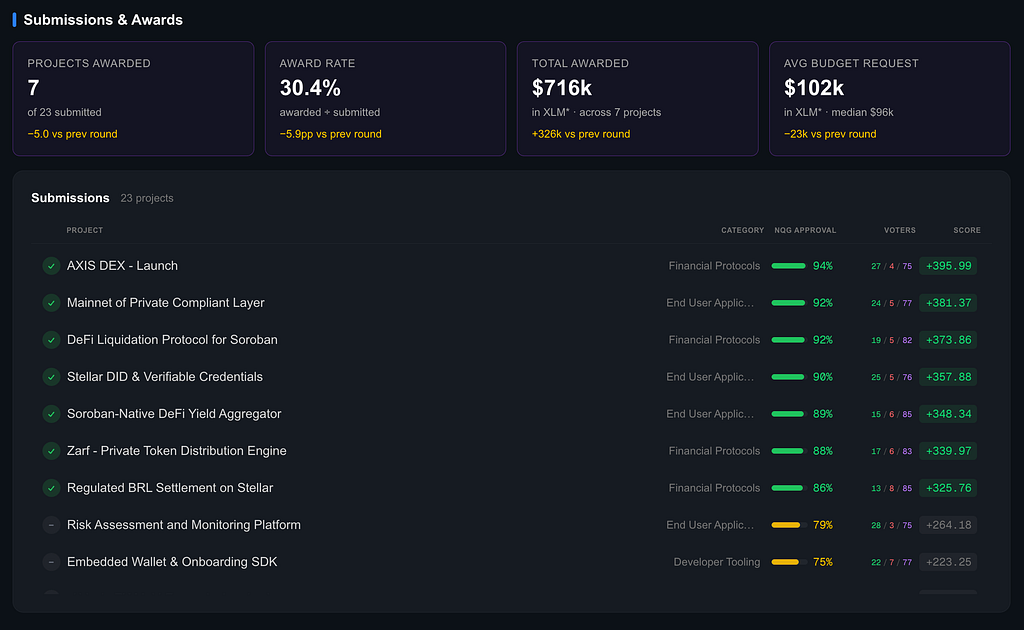
The result this round: 23 Open Track submissions reviewed by 106 voters, with 7 projects awarded. This is the highest voter count in NQG history — up 13% from 94 in SCF #41 — and includes 29 first-time voters alongside 77 returning participants.

The Community Signal
For the second consecutive round, every project the delegate panel awarded was also a top-ranked project in the NQG community vote — maintaining the 100% alignment*** first achieved in SCF #41. SCF #42 sustained the standard set last round, with a clear separation between awarded and non-awarded projects at the >85% approved voting power mark. The SCF 7.0 structure continued to help: with community vote scoped exclusively to Open Track, voters could focus on 23 submissions rather than being spread across all tracks.
Decentralization Measure
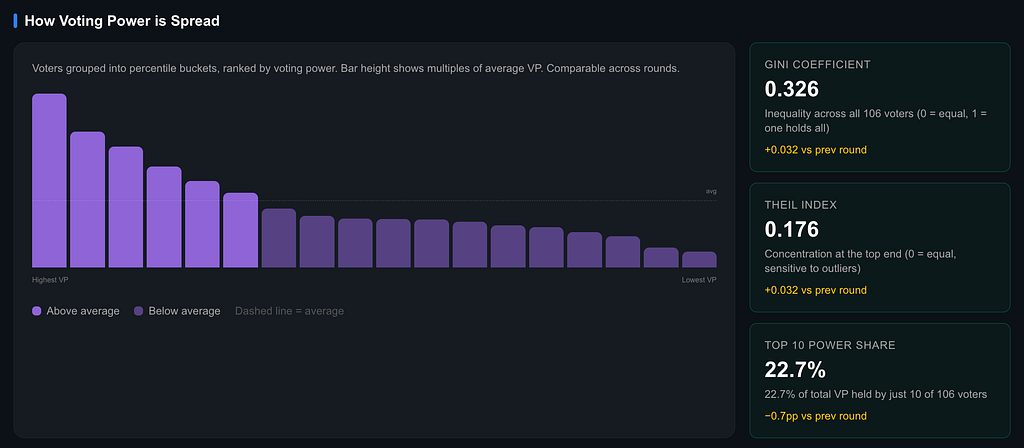
The top 5 voters held just 12.7% of total NQG — down from 13.1% in SCF #41 and 43.6% in SCF #37. Voting outcomes are increasingly shaped by the broad community, not a handful of high-power voters. The Gini coefficient — a standard measure of inequality where 0 means perfect equality — came in at 0.33, while the Theil index rose slightly to 0.18. Both represent modest increases from #41 (0.29 and 0.14 respectively), largely driven by the influx of 29 new voters who enter at lower tiers. As these participants build voting history and accumulate Vote Quality scores, the gap is expected to narrow — the same pattern observed when the post-#39 algorithm changes initially widened the distribution before subsequent rounds compressed it.
Quorum Delegation
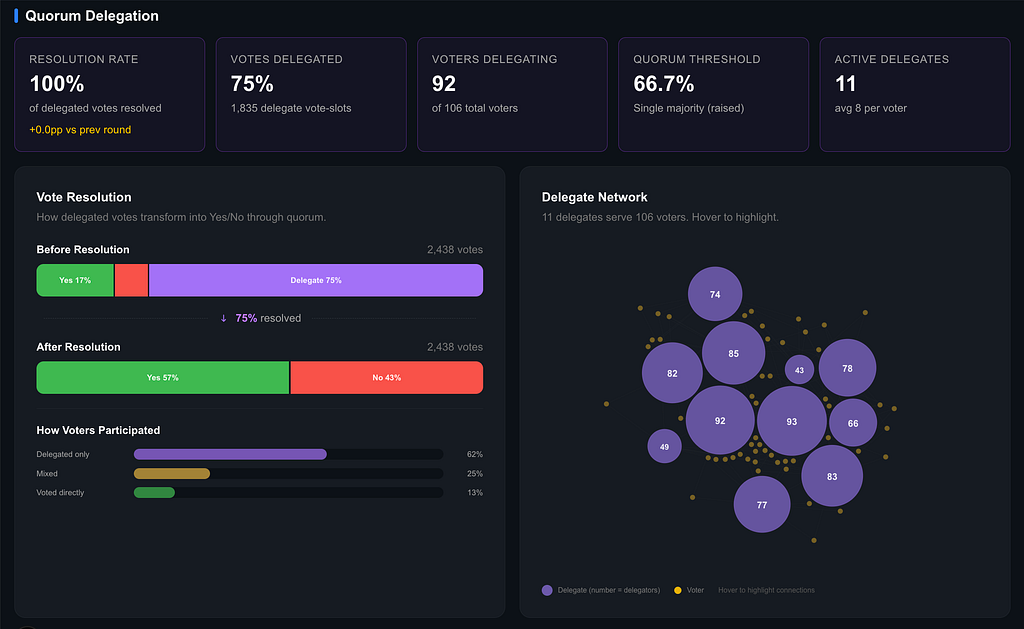
NQG allows voters to delegate their vote to a quorum of trusted community members rather than voting directly on every submission. Each voter selects a panel of delegates (min. 7); if enough delegates participate and a supermajority agrees (>66.7%), the delegation resolves to Yes or No.
In SCF #42, delegation was the dominant mode of participation: 75% of all vote-slots were delegated, with 62% of voters relying entirely on delegation and another 25% using a mix of direct voting and delegation. Only 13% of voters cast direct votes on every submission. This is by design — delegation lets the broader community participate meaningfully even when individual voters lack the time or context to evaluate every project.
The system performed flawlessly this round. All delegated votes resolved successfully — a 100% resolution rate for the second consecutive round, with zero abstains in the final tally. 11 active delegates served the full voter base of 106, with each voter selecting an average of 8 delegates for their quorum.
Neuron Performance
NQG computes each voter’s influence through four “neurons” — modular reputation inputs that reflect different dimensions of a voter’s standing in the ecosystem (see exact parameters in the SCF Handbook). Three neurons are added together (Layer 1), and a fourth multiplies the result (Layer 2), producing each voter’s final voting power.
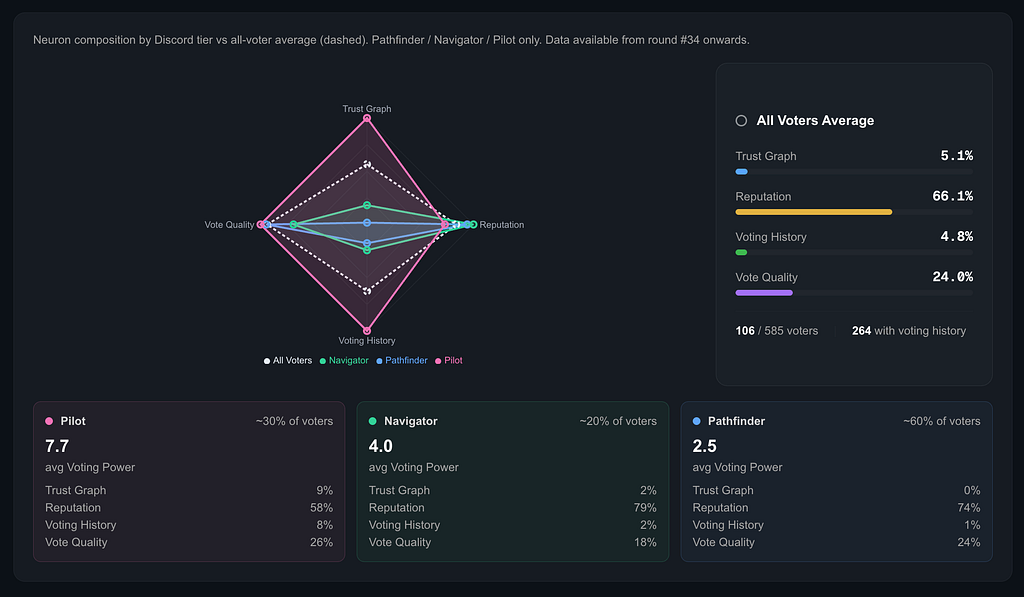
In SCF #42, 106 voters participated across three community tiers: roughly 60% Pathfinders, 20% Navigators, and 30% Pilots. The radar chart above shows how each tier’s voting power breaks down across the four neurons — and the differences are striking.
- Reputation — Base power from the verified tier and other community roles. This is the largest contributor across all tiers, making up ~74% of a Pathfinder’s power, ~79% for Navigators, and ~58% for Pilots. It’s the “floor” that every verified community member starts with.
- Trust Graph — Derived from peer trust relationships via PageRank. This neuron is near-zero for Pathfinders and Navigators but contributes ~9% of Pilot power, reflecting deeper, longer-standing community relationships.
- Vote Quality — A retroactive bonus or penalty based on whether the projects you voted for actually shipped on mainnet. Now in its fourth active round, this neuron’s range has expanded to its widest yet. Pilots average roughly double the Vote Quality score of Pathfinders, reflecting both longer vote histories and better track records.
- Voting History — A participation consistency score that multiplies everything in Layer 1. This is the sharpest differentiator: Pilots average a 0.60 multiplier (out of a max of 0.99) while Pathfinders average just 0.03. In practical terms, a Pathfinder who doesn’t vote regularly sees their entire Layer 1 score nearly zeroed out — this is by design, ensuring that even highly reputed voters must show up consistently.
Pilots average 7.7 total voting power — roughly 3x that of Pathfinders (2.5) — not because the system arbitrarily favors them, but because they’ve accumulated trust, voted consistently, and backed projects that shipped. The system is designed so that new participants start with meaningful voice through reputation, and grow their influence over time by participating and making good decisions.
Looking Ahead
SCF #42 is the second consecutive round where the NQG community vote and the delegate panel aligned completely on award decisions, reinforcing the mechanism’s maturity. With 106 voters — the highest participation in NQG’s history — and zero unresolved delegations, the system is demonstrating both scale and stability.
For a full deep dive into NQG’s evolution, see the Two Years of Neural Quorum Governance retrospective (link coming soon). To learn more about how NQG works and how to participate, visit the SCF Handbook. If you’re interested in participating in the community vote and helping to shape the future of the Stellar ecosystem, become verified today and participate in the discussion on the Stellar Dev Discord!
SCF #42 Round Recap was originally published in Stellar Community on Medium, where people are continuing the conversation by highlighting and responding to this story.